
August 27, 2026
Jogging with G. K.: Emphaticall
“I told my wife you look like Tom Cruise,” I blurted to a passing runner. He seemed nonplused. I had felt an urge to make some human contact since I’d seen him so often on the jogging path but had never spoken. Next time we met, he reigned in his dog and remarked, “My wife laughed when I told her what you said.” Now I was nonplused. A few weeks later I realized I had confused facts and faces: I had said “Tom Cruise,” while the gentleman looked remarkably like a paunchy, unkempt version of Tom Hanks. No wonder his wife was amused.
How do we communicate encountering a colleague in the hallway or standing behind a stranger in the grocery line? It’s a significant question since our fast-paced culture increasingly reduces our communication with others to blips of texting and twitters, sound bites and mumbled grunts. Chesterton always affirmed that words matter. “Why do we choose one word more than another,” he asked, “if there isn’t any difference between them? If you called a woman a chimpanzee instead of an angel, wouldn’t there be a quarrel about a word? If you are not going to argue about words, what are you going to argue about? Are you going to convey your meaning to me by moving your ears?” In linguistic theory our “throw away” comments about sports or weather fall into a category called “phatic communion.” Phatic communion represents a form of pre-symbolic language used to replace gestures, to fill awkward silences. This meaningless banter emerges when people interact in such close proximity that gestures (a wave, nod, or wiggle of the ear) won’t suffice and where the relationship “glue” is not strong enough to bear the weight of symbolic language. To use symbolic language in such a case might obligate us to go beyond the surface, which could prove uncomfortable. The arbitrary phrase has no real meaning, but is employed instead to ease an awkward silence. “How about Manchester United and Chelsea last week?” “Corn looks good this year, doesn’t it?” “Hear a storm is supposed to blow in.” Sometimes Phatic language takes on a terse or even pessimistic tone as in the caricatured Minnesotan. Erik: “How ya doin’, Sven?” Sven: “Could be worse.”
For years my wife, Kimberly, and I have noticed phatic language among joggers. Take Ed, for instance, who farms nearby. We would see him walking toward us in the morning two or three times a week. Though not much of a talker, Ed’s winking sense of humor gradually became apparent. He’d say things like: “Better pick up the pace if you want to make it home by lunch,” or “You two are slowing down in your old age.” If he saw me running alone, he’d snicker: “What! Did she finally leave you?” or “Looks like she outran you today.” More recently we have encountered a gentleman riding a recumbent bike. Whenever we pass him, he sings out his mantra: “Beautiful day, beautiful day” (always repeated twice—as though part of the liturgy). Of course some of the best phatic language comes “pre-packaged.” My favorite line comes from my father-in-law. As you approach him, he grins: “You always see your best game when you leave your gun at home.”
Seven years ago, when we first began greeting Ed on the road, I discovered a dueling side to phatic communion on the run. The brief amount of time to respond and impromptu nature of the engagement presents a challenge of wits. Unless you initiate you have no idea what is coming which forces you to respond on the spot. We were walking the loop of our subdivision last night (about “dark-thirty” as my father-in-law likes to say) and we saw some neighbors approaching, a couple in their late sixties. I shot first: “Do your parents know you are out this late?” On the next lap she quipped, “What’s wrong, can’t find your house?” The aim is to be creative while avoiding a critical or disparaging spirit. This morning an elderly man on a bike, whom Kimberly and I have not seen for some months, commented to us both: “You sure are running her hard; look how small she’s getting.” On the return leg of the run we passed again, but I didn’t notice him until at the last second I yelled, “You must be running for Congress!” As he cheerfully nodded agreement, Kimberly chimed in: “Well, I’m voting for you.”
Phatic communion on the run helps me recognize the power of even the smallest word-encounters. Each passing phrase illustrates, first, how dear meaning is to our species. “It is impossible for anything,” insisted Chesterton, “to signify nothing.” Even more significant, however, is that each human being we meet offers an opportunity for blessing another. As Our Lord teaches us, there are no throw away words, no throw away people.
August 14 31, 2026
Theology of Place: Taking Port William with You
Early chapters of Genesis lay out a key premise of Christian thought and theology: namely that God created human beings as embodied, embedded creatures, planting them in places like gardens to work and play, live and flourish. Catholic theology particularly emphasizes that the Spirit of God comes to us through material stuff: water, oil, bread, wine, buildings and holy places. Every Mass we are reminded that God Incarnate gives himself to us through things embodied. Increasingly, however, our culture offers us a disembodied reality through technologies that displace us, leaving us isolated, lonely, and disoriented. It is this sort of modern tendency we at Fish on Friday hope to resist, to challenge, by offering an alternative model. Family, faith, friendship, food, fun, festivals—all these return us to a situated embodied relationality.
Paul Kingsnorth, in his 2025 book Against the Machine, reminds us that to be human means to be rooted, planted in something like a garden, a place. Human culture, according to Kingsnorth, flourishes (grows well) when it is planted in soil that includes four ingredients: past, place, people, and prayer. Quoting author Simone Weil, Kingsnorth emphasizes our need for roots:
To be rooted is perhaps the most important and least recognized need of the human soul. It is one of the hardest to define. A human being has roots by virtue of his real, active and natural participation in the life of a community which preserves in living shape certain particular treasures of the past and certain particular expectations of the future … Every human being needs to have multiple roots (1).
But instead of embodied, planted, embedded, rooted lives, we find ourselves increasingly disembodied and uprooted.
For years I taught Wendell Berry’s novel Hannah Coulter to senior college students at Spring Arbor University in Michigan. Berry’s novels are situated in the fictional town of Port William. It is a rooted place, with a past full of people who know each other, who recognize the human value of what Berry call “membership” in the community. People in Port William belong. Yet the story laments the dislocation of small rural agricultural towns across America beginning in the post war 1950s. Largescale agribusiness almost inevitably replaces the small family-owned farm as tractors replace horse plows and pesticides replace careful generations of planned rotated crops. As a United Methodist pastor of small rural towns in Illinois, Indiana, and Michigan, I witnessed this loss. Big box stores twenty miles away—now fueled by globalism’s temptation of cheaper prices—ensured the demise of local hardware stores, drug stores, and mom and pop shops.
“How many of you grew up in a town like Port William?” I would ask my class of thirty students. Sometimes two-thirds of the class would raise their hands. They would name small towns in Michigan, towns many of our readers would recognize. I’d ask them about the benefits of growing up as children in a town like that and the result was wonderful: stories of fishing, climbing trees, grandparents, cousins, and family dinners. “How many of you will return there after you graduate?” Often, not a single hand. “Why?” I would ask. Mostly it was a matter of jobs. Sometimes, of course, the town was now too small for them, like Bedford Falls was too small for Jimmy Stewart’s character, George Bailey, at the beginning of the film It’s a Wonderful Life. The next question was what I was most interested in: Is there a way to bring the blessings of Port William into where you will go from here? These were seniors in college, mind you. They were leaving friendships forged over four years of struggle, learning, and fun. Many were terrified about what lay ahead. They all wanted a healthy community for their future, with genuine relationships, and virtually none of them knew how to achieve it.
One solution is to move to a particular place with like-minded people and establish community together. It may be difficult to forge community in one of America’s largest or fastest growing cites, for instance LA, Seattle, or Denver, although people could decide on a particular neighborhood and endure possible long commutes or
begin by rooming together. Grand Rapids, perhaps, comes to mind as a good destination: geographically small, plenty of job opportunities—and the per capita number of coffee houses doesn’t hurt. But even that may not promise a permanent solution to the problem. People move away for a variety of reasons: they marry someone in a different state; they return home, closer to family or aging parents; or they simply become restless. Mobility in our culture means that some folks will be pulled away by job changes; Americans move on an average of every five to six years.
Another way to maintain the spirit of Port William no matter where you end up can be seen through what my group of college friends has committed to for forty-five years. Seven of us pledged ourselves to friendship for life, which has included shared weddings, funerals, yearly canoe and camping trips, and more frequent one-on-one rendezvous. This past summer we met for five days at a Lake Michigan Airbnb to watch the World Cup together and discuss life. Several of our nieces and nephews watched this example of friendship as they grew up and reproduced the model with their college friends. Family reunions and shared holidays can play this role as well.
Most importantly, perhaps, consider Kingsnorth’s notion of humans rootedness in place, people, past, and prayer as an invitation for churches to inspire the kind of community-building I am describing. In other words, what if we began with churches fostering intentional communities? For example, an Orthodox church in our area has been building community for over twenty years, so satisfying that people refuse to move for fear of losing their faith community. Instead of moving with a job, congregants either find other jobs, learning to retool their skills or work at jobs they find less than fulfilling (at least for a while). In the meantime, they concentrate on people, friendships, and faith—on building a home with their children, who are friends with their friends’ children. Our daughter has taken a slightly different route. She, her husband and two girls, live outside the densely populated area of Washington, DC. They bought a condo and began inviting friends from their church in Alexandria, Virgina, to move to the complex. These neighbors have gradually developed a group of friends who share faith, small groups, childcare, parties, and camping trips. It’s an expensive area and the condos are not spacious, so who knows how long they will all be able to stay. But the point is this: they have learned how to bring Port William meaningfully to urban life.
(1) Kingsnorth, Paul; Against the Machine: On the Unmaking of Humanity (2025)
July 31, 2026
Magnifica Humanitas: On Safeguarding the Human Person in the Time of Artificial Intelligence
What does it mean to be a human being? Are some people more human and some less so? Can a machine be human? Scripture and Catholic theology clearly teach at least three things about what it means to be human. First, being created in God’s image means that human beings are relational creatures (since the Triune God is relational). As the Catechism explains, “By sending his only Son and the Spirit of Love in the fullness of time, God has revealed his innermost secret: God himself is an eternal exchange of love, Father, Son, and Holy Spirit, and he has destined us to share in that exchange” (CCC 221). Second, we learn through the Incarnation of Jesus Christ that human beings are embodied creatures, neither angels nor animals, but [fragile] enfleshed souls. Bodies and materiality, the stuff of the world that God created, is good. Third, God created us with freedom so we might choose to love and worship freely. Pope Leo XIV in his recent encyclical, Magnifica Humanitas, recognizes that technology may encourage human beings to be less human: less relational, less embodied, less free to choose the good. As his subtitle suggests, his main concern is to safeguard our understanding of the human person.
Pope Leo’s intent is both catechetical and pastoral. We might say he steers a middle course between the theological understanding of someone like Pope Benedict XVI and the pastoral concern of Pope Francis. Leo hopes to teach and shepherd his flock. Particularly, what it means to be a human being with free will lies at the center of the encyclical, as does the question of how technology makes us more human or less, depending on how we choose to use it. There’s a clear spiritual choice before us. C. S. Lewis frames this choice well in Mere Christianity when he writes: “Every time you make a choice you are turning the central part of you, the part of you that chooses, into something a little different than it was before. And taking your life as a whole, with all your innumerable choices, all your life long you are slowly turning this central thing into a heavenly creature or a hellish creature…”
Choosing technology wrongly clearly makes people less human and more hellish. Pope Leo urges us to become more fully human by choosing to use technology with love—with love of God and neighbor in mind. However, the purpose of Magnifica Humanitas is not to reject technology as evil. Human beings, after all, are creators just as God is Creator. We are tool makers. Nor is it Pope Leo’s purpose to supplant the work of the civil sphere, but rather to call our culture to moral responsibility and reflection. For example, technology stands as an integral part of what it means to be human creators. Yet, Pope Leo XIV acknowledges that AI represents a particularly dangerous challenge: “It is necessary,” he argues, “to establish adequate regulatory tools capable of upholding justice and curbing the distorting effects of technological power” (12). AI, according to Pope Leo, represents “a valuable tool that requires vigilance” (89). Chapters one and two interpret the history of Catholic Social Teaching, from Leo XIII’s Rerum Novarum, through Vatican II down to the recent Magisterium, explaining how the Church invites dialogue with scientific and technological cultural currents.
A framework of either/or is clearly established in the encyclical: will we choose the good or the merely efficient and profitable? Leo uses Augustine’s image of two cities governed by two loves as an example of either/or—will we choose the City of God or the City of Man— “on the one hand, the love of God and neighbor; on the other, the exclusive love of self” (110). Throughout the encyclical power and dominance that dehumanize stand in stark contrast to love—a love that acknowledges human limits and vulnerability—the sort of love illustrated most obviously in Christ’s crib and cross. “We must remember that humanity flourishes not despite limitations, but through them” (101).
This contrast of two cities is illustrated through two opposite biblical images: the tower of Babel and the rebuilding of the Jerusalem wall by Nehemiah and his community. “Babel … reveals the limits of any effort that, however grandiose, arises from self-affirmation, sacrifices human dignity for efficiency and aspires to reach heaven without God’s blessing.” Compare Babel’s building project with Nehemiah’s effort to rebuild the walls of Jerusalem: the latter is “an undertaking with God at the center, which builds relationships before building with stones” (15). Similarly, in “The construction site of our time” section, the Pope urges us to: “cultivate what Pope Francis called a ‘situated anthropocentrism,’ which recognizes the human being as a creature embedded in a network of relationships with other living beings and with all of creation” (183). Following Nehemiah, our construction projects can be more embedded and relational.
Each of us must choose how to interact with today’s rapidly growing technology keeping in mind what it means to be fully human. As I sat with a group of Catholic friends discussing the encyclical on a back porch one evening last week (many of whom use AI at work), it became clear that Pope Leo XIV never intended the encyclical to answer specific questions about how to use AI. Instead, he gives us guidelines so that we might approach technology with a spirit of Christian love and faithfulness: “Ultimately, the key question remains the one posed by Saint John Paul II: does AI ‘make human life on earth ‘more human’ in every aspect of that life? (109).
Finally, Pope Leo extends an invitation that fits well with our purpose at Fish on Friday:
“I invite everyone to cherish places and times where physical presence remains crucial, such as shared meals, Christian community gatherings, time spent with the lonely and serving the poor. These are signs of a humanity that continues to believe that every person’s body is a dwelling place of God and a temple of the Holy Spirit. It is precisely this covenant between glory and fragility that becomes the criterion for evaluating the anthropological models offered by contemporary culture” (184).
Why not get together with a group of faith-filled friends to read, discuss, and apply Magnifica Humanitas? Let’s become more human by becoming more Christ-like: free to choose God, to build genuine relationships, and to embrace our embodied finitude.
July 2, 2026
Sabbath as Play
At Fish on Friday, we never tire of proposing the idea of transformation of Catholic culture in the Great Lakes Region through faith, family, friendships, and fun. Today, I’d like to explore the Sabbath as a relationship between faith and fun, between prayer and play—aspects of our Christian lives we often do not set side by side.
Perhaps we do not consider play as a part of prayer, or faith as fun,
because we easily forget who we are, who God is, and how God
created us—what he created us for.
Perhaps, like me, you were raised with a rather stern Sabbath
narrative, one requiring stiff shoes, uncomfortable clothes, and all
sorts of restrictions seemingly prescribed to quash fun. That is
certainly not the only, nor would I say the most helpful Sabbath script.
It is true, as Jewish theologian Abraham Joshua Heschel indicates
that Sabbath time seeks to free us from work. Let me quote Heschel:
There is a realm of time where the goal is not to have but to be, not to
own but to give, not to control but to share, not to subdue but to be in
accord. Life goes wrong when the control of space, the acquisition of
things of space, becomes our sole concern.
We seem to have such little time today—to the extent that resting on
the Sabbath may feel like a burden to modern people. When Pascal
suggested that “All of humanity’s problems stem from man’s inability to sit
quietly in a room alone,” he pointed to our human dis-ease with slowing
down.
In earlier blogs I suggested that healthy families and friendships
require two things—elements so obvious we often fail to see
them—space and time. We need to have shared spaces—places
where we can talk and play, laugh and cry, ask questions, share ideas,
make common meals, and enjoy celebrations—and we need the time
for doing these things; and time, it seems, is the one thing we most
lack these days.
It is important to ask what we are as human beings—what we are
essentially. Aristotle maintained humans are political animals. Many
Greek philosophers used observations from the physical world to
explain what humans are. When Plato labeled man “a hairless biped,”
his opponent—the Cynic philosopher Diogenes—brought a plucked
live chicken to Plato’s school, set it down, and announced, “Here is
Plato’s man!” However, science or examination of the material world
alone cannot tell us enough about human uniqueness; for instance, it
is not enough simply to trace human origins from homo erectus to
homo sapiens and beyond. What of the human soul or mind, what of
love? God created human beings in his image, of course. We confess
God first as Father, Almighty, creator of heaven and earth. As Creator,
God works, he spends six days making things—the first three forming
the world, the second three filling what he formed. As creatures
sharing his image, he calls us to make things, too: to co-create with
him, to steward his creation, to act as what J.R.R. Tolkien called “sub-
creators.” Considering the ancient cave paintings, G. K. Chesterton
famously claimed, “Art is the signature of man.” Like God, human
beings create meaning. Thus, the Catholic poet and artist David Jones
described man as a “sign-maker,” as a “sacramental animal.” So, six
days a week, we human beings work (alongside God) to earn our
bread, to make the world better, and to create beauty.
Bishop Robert Barron likes to emphasize our human uniqueness
as worshipping creatures. The designation of humans as homo
religiosus fits here—human beings are essentially religious creatures.
This moves the question from what we are (our nature) to our purpose
(our destiny)—what we were made for. When we ask what we were
made for, we can answer that we were made to worship God. Bishop
Barron often describes the Mass as “the most useless thing we do,”
since worship is not a means to an end, something we do to get some
result, but rather something we do for its own sake—like building
friendships or playing a sport. Following authors G. K. Chesterton,
Romano Guardini, Johan Huizinga, and Joseph Pieper, Bishop Barron likens liturgy and worship to play. As Huizinga maintains, “In play
there is something ‘at play’ which transcends the immediate needs of
life and imparts meaning to the action. All play means something.” So
Barron points to the unnecessary elements in the ritual Mass of
vestments, liturgical colors, processions, genuflections and
gestures—all of which look like dance or play.
Why did God create? We affirm God needs nothing outside
Himself; he does not create out of requirement or lack. According to
the Catechism, “[Creation] is not the product of any necessity whatever
but rather proceeds from God’s free will; he wanted to make his creatures
share in his being, wisdom and goodness” (CCC P. 295). God freely
creates. May we not still ask why? Again, the Catechism declares:
“God has no other reason for creating than his love and goodness:
‘Creatures came into existence when the key of love opened his hand’”
(CCC 293). God, as Trinity, as Three in One—the eternal exchange of
love—shares his love through the creation of other creatures capable
of feely choosing and returning love.
Of course, as God worked and created, we too must work and
create, and work can be a form of love—of something like art, or as
self-giving for others. But work is not without limit. We are more than
what we do. Again as theologian Abrahm Joshua Heschel suggested:
Six days a week we wrestle with the world, wringing profit from the
earth; on the Sabbath we especially care for the seed of eternity
planted in the soul. The world has our hands, but our soul belongs to
Someone Else.
What about the Seventh Day? We know God formed the heavens
and the earth and filled them with all manner of good of things in six
days, including the creation of man and woman made in his image,
planting them in a garden they called home. What work, then,
remained for God to do? Indeed, what did he do on the Seventh Day?
To say that God rested on the seventh day is true enough but perhaps
misleads us into imagining he grew weary from all his work and
needed a nap. To suggest that on the Seventh Day God enjoyed all that he created is nearer the truth. Consider the creation narrative in Tolkien’s Silmarillion: “In this Music the World was begun; for Ilúvatar
made visible the song of the Ainur, and they beheld it as a light in the
darkness.” It is as if God grants to the angels the co-creating capacity
through music so that he can enjoy the symphony they create. Recall
also the creation story in C. S. Lewis’s Narnia series, which occurs in
The Magician’s Nephew, and how Lewis depicts God in Narnia as the
lion Aslan who sings creation into being. And remember Aslan’s
relationship with the Pevensie children—especially with Lucy. Would
it be too much to suggest that on the Seventh Day, God had a
romp—that he played with his children—enjoying all that he made:
music, art, beauty, friendships, and love? Fish-on-Friday’s mission
statement hopes to call us all back to these human basics: taking
time for God, faith, family, friends, and play—what we are made for;
what the Sabbath calls us to.
June 19, 2026
Who’s Going with You?
At Fish on Fridays, we believe in the power of friendship to transform Catholic culture. Think about Jesus gathering his group of twelve friends as a way to form faith; recall how Saint Francis and Saint Ignatius each had a band of brothers; consider the power of Christian imagination that emerged from the Inklings.
From the start of the journey, Frodo’s friends promise to stay by his side: “You can trust us to stick to you through thick and thin—to the bitter end,” says Merry. “We are horribly afraid—but we are coming with you; or following you like hounds.” Of course, at this point, none of them know they are signing up to face ringwraiths and orcs together. Other members of the Company avow the same pledge of loyalty. As the fellowship departs from Rivendell, Elrond reminds the group that they are not bound by any oath, and that each may decide for himself to turn back if the darkness becomes suffocating. Gimli’s reply functions almost as a lord-vassal fealty ceremony in the narrative.
“‘Faithless is he that says farewell when the road darkens,’ said Gimli.
‘Maybe,’ said Elrond, ‘but let him not vow to walk in the dark, who has not seen the nightfall.’
‘Yet sworn word may strengthen quaking heart,’ said Gimli.”
As the story progresses, when danger increases, so does the Company’s commitment to one another. Gandalf stands on the bridge of Khazad-Dum to hold off the Balrog so the others can escape. The fleeing Aragorn turns back and shouts, “He cannot stand alone!” Boromir, too, turns ready to face the foe. Courage is multiplied with trouble. Friends stick together.
This is emblematic of the kind of loyalty demonstrated within the fellowship from start to finish, and it is symbolized in Anglo Saxon literature in the story of the Battle of Maldon of 911. The story also illustrates an element of the Anglo Saxon worldview that I would like to highlight, that of heroic (elegiac) courage. The Anglo Saxons are far outnumbered by a hostile band of Viking warriors, but the Saxons have the superior position situated on the mainland. As the fighting begins, the Vikings lose man after man while each attempts to cross a narrow land bridge from the island they have alighted on. After great losses, the Viking dryghten parleys with his Anglo Saxon counterpart, saying something like, “These circumstances are not fair. Let my warriors cross over onto the land and then we will have a true match of courage.” One imagines that the Saxon warriors would prefer their dryghten to decline the offer and keep the military advantage instead. He does not. He graciously allows the Vikings on to shore, whereupon his men proceed to get their Anglo Saxons kicked. But as two thegns are fighting and dying side by side, they refuse to slander their dryghten for mismanaging the battle. Instead, they pledge that they will remain loyal and that their courage (mod in Anglo Saxon) will increase with the danger. One is reminded of Sam’s great courage against all odds when he discovers that Frodo has been captured by orcs. “His weariness was growing but his will hardened all the more.” Or we recall Meriadoc Brandybuck, just relegated to the baggage of the Rohirrim, finding himself in battle on Pelennor Fields, at least partly as a fulfillment of his previous pledge to Denethor to serve Gondor—Merry Brandybuck of the Shire facing the Lord of the Nazgul, “and suddenly the slow-kindled courage of his race awoke.”
Loyalty and courage of this stripe is a major theme in TLR. Again and again, Frodo is reminded by his friends: “You are not alone.” At the end of TFR, when the Company discusses whether it wouldn’t be wiser to split up, sending a smaller group to Mount Doom, Aragorn says, “It would indeed be a betrayal if we all left him.” In fact, none of the hobbits can bear the thought of being separated from their friend Frodo. Sam, though he is the most fiercely loyal toward Frodo, is nevertheless only an exaggeration of what the other hobbits are committed to. Of course you must go at once, concedes Sam on the last page of the first book, “But not alone. I’m coming too, or neither of us isn’t going. I’ll knock holes in the boat first.” Frodo responds with relief: “I’m glad, Sam. I cannot tell you how glad. Come along! It’s plain that we were meant to go together.”
Now, this worldview that J.R.R. Tolkien created with Middle Earth had tangible parallels in the lives of Anglo Saxons before and during the golden age of Bede (after the mid 700s CE). Let us back up our timeline for a moment. At say 362 C.E., barbarians and Christians were essentially in separate worlds. But by the mid 600s, many of the Germanic and Celtic tribes had been reached with the Gospel (St. Patrick, Finian of Clonard, and Columba had evangelized the Irish and the Scots by the mid 500s; Clovis, the Frankish king, had accepted the Nicene faith in 496; and Augustine of Canterbury had converted 2 Aethlberht, king of Kent in Britain in 601). However, when we examine the initial interactions between Christian missionaries and the so-called barbarian tribes in the west (people groups like the Irish, Scots, Angles, Saxons, Lombards, Franks, Frisians, Alemanni, etc.)—when we examine the initial interactions between these two culture groups, we discover a difference of opinion among scholars as to the result or value of the interchange. On the one hand you have a thesis like that of Thomas Cahill, that, indeed, the Irish saved civilization. 1 If you ask Cahill how they saved civilization in the west, his answer is not all that sophisticated. He responds by copying manuscripts; by saving the literature (as our cultural and intellectual heritage). Justo Gonzalez states the case much better. Speaking of the “dark ages,” he maintains:
It would …take centuries to rebuild much that had been destroyed, not only in terms of roads, buildings, and aqueducts, but also in terms of literature, art, and knowledge of the physical world.
In all these fields, it was the church that provided continuity with the past. She became the guardian of civilization and order. In many ways, she filled the power vacuum left by the demise of the Empire.” 2
For Gonzalez, three streams converge: Roman Empire, Germanic tribes, and Christian faith. And it is the Christian stream that subsumes the other two in the end. If an illustration to support Gonzalez’s view were
required (that Christianity and barbarians were not such a bad mix after all), then St. Patrick would be a good candidate. Loyal friendships and faith transform culture.
But not everyone would agree with Gonzalez. In his book, A World Lit Only By Fire, William Manchester negatively evaluates the interface between barbarians and Christians. Pointing to the “brutality, ignorance, and delusions in the Middle Ages,” Manchester concludes: “Christianity survived despite medieval Christians not because of them.” 3 In his mind, the Christians are even more barbaric than the barbarians. If you wanted an illustration to support Manchester’s view (that the mixture of Christianity and barbarian was nothing to write home about), then Clovis, king of the Franks, might be a good candidate. Suffice it to say, that Clovis likely accepted the Nicene faith in part as a political tool against the Arian Christianity of the surrounding tribes that he opposed. According to historian Roland Bainton, “for Clovis … Jesus was a tribal war god.” After the so-called conversion of the Franks in any case, let’s just say manners did not improve a great deal in the royal (recently converted) court. Again, listen to Bainton: One queen requested that if her two physicians failed to cure her they be executed. She died and the king fulfilled her request. A duke buried alive a servant and a maid because they had married without his consent. One priest who had obdurately refused to surrender some property to the bishop of Clermont was buried by him together with a corpse. 4 If one was to argue that a Christianity mixed with some form of Germanic or Celtic culture is a
good thing, others might say no precisely because of the inevitable dilution or diminishing of the Christianity within that equation. Distortion of pure Christianity is bound to occur with any admixture. For the sake of discussion, it could be posited that Christianity always intersects with its “host” culture, that a blending of elements is not only certain, but sometimes desirable, and if one can affirm that Anglo Saxon Christianity became a daring and healthy new synthesis—orthodox in its understanding of Christianity, yet emphasizing different features of the Gospel with bold new strokes—then might not one also claim—in our postmodern, post-Christian era—that the worldview conveyed through Tolkien’s Middle Earth has the
potential to reinvigorate our culture’s worn and weary conceptions of the ancient faith (even in the internet age).
I must admit that when I first started writing on TLR—before the first movies appeared—I was struck by the contrast between the courage displayed in the story and the complacency of our current western culture. However, I think we have also begun to admit, in a new and urgent way, our utter dependence on forces outside ourselves—if not upon God alone. Seen through the lens of Tolkien’s worldview, life for us in recent decades has become darker, colder, crueler, and more precarious. Perhaps we recognize in a personal and dramatic way the fragile nature of our existence. As the Psalmist sighs: “You have made my days a few handbreadths, and my lifetime is as nothing in your sight. Surely everyone stands as a mere breath. Surely everyone goes about like a shadow. 5 ” Or, as Pascal exclaimed, it takes but a drop of water to kill us. It is precisely in dark times like ours that we as Catholics hold the greatest opportunity to shift the culture—even as Catholics shifted the worldview of the Anglo Saxons. The illusion of our invulnerability has been shattered—especially in America—and shattered illusions can be a good thing. Recognized vulnerability may breed faith and the friendships we all need along our journey home to God. Perhaps a new self-understanding can begin to unravel some of the destructive, selfish, materialistic individualism of our culture. Remember that you are only as strong, as good, and as virtuous as your five best friends (your Sam, Merry, Pippen, Gimli, and Aragorn—and let’s not omit Legolas).
1 Thomas Cahill, How the Irish Saved Civilization. New York: Doubleday, 1995.
2 Justo L. Gonzalez, The Story of Christianity, Volume One. New York: HarperCollins, 1984: 218.
3 William Manchester, A World Lit Only By Fire. Boston: Little, Brown & Company, 1993: xviii.
4 Roland H. Bainton, Christianity. Boston: Houghton Mifflin, 1992: 139.
5 Psalm 39:5-6a, NRSV.
June 5, 2026
Facing the Dragons Together
Mojo
A few summers ago, it had been almost forty years since I had read The Lord of the Rings (TLR). Knowing that the first movie was scheduled to appear that next fall, I made time to re-read the first book. Not surprisingly, The Fellowship of the Ring was as riveting as the first time I read it, keeping me awake late into the night. Last summer, I read once more books two and three in the trilogy. Again, I found them alluring, enthralling, spellbinding. How do we account for the persistent appeal of Tolkien’s writing? First, isn’t it true that continued fascination with Middle Earth is due in large part to the worldview Tolkien creates? Second, is Tolkien’s worldview compatible with a Christian worldview—and if so, how and where? One might argue that the collision of Christianity with another worldview is at times not merely something to tolerate, but something to applaud, something, that is, which actually reinvigorates Christianity.
What is it, then, about Tolkien’s Middle Earth that captivates us so? One would expect American audiences during the tumultuous decade of the 1960s to identify with the story’s battle against evil wraiths, orcs, a Balrog, and the temptation of the ring itself. But today, amid our mainly prosperous and placid culture, I think there are two different, rather compelling reasons for the continuing appeal of TLR. First, because we live our lives in self-indulgent suburban isolation, the picture of community in Tolkien’s work sets aflame a longing within us. We work in cubicles and do not speak regularly to our neighbors. Covid 19 further isolated us and social media is a flimsy substitute for physical contact. So, what strikes us in the title of the first book is the phrase fellowship of the ring. Yes, the story is about our singular hero, Frodo, but even more, it is about “the Company,” the fellowship—it is the story of a group of loyal comrades who have bound themselves together for good or ill. Together they feast in Rivendell; and together they face the dark, dank mines of Moria. We long for relationships like this, if not for the adventures themselves—which brings me to the second reason why TLR intrigues us so. The imaginative adventure that the quest propels us into stands in stark contrast to our stale, stultified suburban existence. While we drive SUVs and wear fashions that imitate exploring gear, while we talk about risk, survival, and living on the edge, we mostly watch others take risks while we live on the edge of our safe couch at home.
None of our culture’s passivity, however, nullifies the real appeal of Tolkien’s world for us. The energy and lure that the trilogy exudes derives at least partly from the world and worldview that Tolkien used as a pattern for middle earth—that of the Anglo Saxons. Speaking in broad strokes, here, let me mention three (of the half dozen or so) components of the Anglo Saxon worldview that Tolkien employs.
The first aspect of the Anglo Saxon worldview we might consider under the rubric of Vast Expanse. When one enters the land of hobbits, one is immediately thrust into a world that is broad, wild, and uncharted. I recall a speech from the Venerable Bede that one of my college English professors used to narrate. I have altered it poetically in my own imagination over the years, but I think that the main point is still intact. The dryghten’s (or lord’s) advisor is describing for the dryghten what life in the world is like. Life is like a sparrow flying through a storm in the dark night, says the advisor. The world is dark and vast and cold. The rain slashes and the wind beats against the fragile creature. Then, suddenly, all is changed. The sparrow flies into the mead hall through an open window where the dryghten and thegns (vassals) are making merry. The firelight spreads light and warmth and cheer throughout the room. Voices are laughing and hearts are singing. Then, after the sparrow briefly experiences light and comfort, it quickly flies out again through a window at the far end of the hall, into the cold dark. The light and cheer were real but brief. So, in the TLR, there are moments of peace—with Tom Bombadil, in Rivendell or Lothlorien, or drinking treegrog in Fangorn, or smoking some unexpected vintage Longbottom Leaf amidst the flotsam and jetsam of uprooted Isengard —but the golden moments are only brief respites along the longer, much gloomier path.
In one sense, the expanse is geographical, represented by great blank spaces in the available maps. How does one respond to the fact of such unexplored terrain? At the beginning of the trek, as they leave the lands they know, the hobbits cannot imagine what lies ahead. “They would soon now be going forward into lands wholly strange to them, and beyond all but the most vague and distant legends of the Shire, and in the gathering twilight they longed for home. A deep loneliness and sense of loss was on them.” The world is wide and wild and, unless we are fools, that fact is daunting. Theirs is a serious pilgrimage, indeed. As the travelers move on in their quest, there is increasingly more that must be added to their sense of proportion: “the world looked wild and wide from Weathertop;” “they were oppressed by the loneliness and vastness of the dolven halls and endlessly branching stairs and passages” within the mines of Moria. Middle earth just keeps expanding as we continue the journey, and as it expands, it is as if the hobbits grow smaller still. Coming to terms with one’s smallness in the universe means facing finitude. At the recognition of our smallness, a pain both of dread and loss shoots through us. What can our existence mean in relation to all those other unknown lands and lives, let alone the unsought dangers of darkness? All experience of light and joy and beauty fade so fast. Finding the front door to Mordor closed to Frodo, the narrator pities him, saying, “here he was a little hafling from the Shire, a simple hobbit of the quiet countryside, expected to find a way where the great ones could not go, or dared not go.”
In another sense, the vastness stretches not only geographically forward, but also historically into the distant past. One steps out from his or her safe and comfortable hobbit hole and suddenly realizes that one has never fully understood the immensity of time, of eras gone by and full lives lived. As Tom Bombadil told his stories, the hobbits “had a vision as it were of a great expanse of years behind them, like a vast and shadowy plain over which there strode shapes of Men…,” and similarly at Elrond’s house they heard “histories and legends of long ago,” and so, “visions of far lands and bright things that [they] had never yet imagined opened before [them].” There is a poignant scene in The Two Towers where the solitary heroes Frodo and Sam, mulling over the lore of old, suddenly realize that they themselves are living within just such a legend. Sam exclaims, “Why, to think of it, we’re in the same tale still! It’s going on. Don’t the great tales never end?”
There is a strong element of lament connected with this vision of the past, since it instantly awakens one to the passing of all things beautiful: “Baldr the Beautiful is dead, is dead” echoes a plaintive line from an Icelandic poem.1 “Time like an ever rolling stream bears all her sons away.” 2 Lothlorien is passing away and elves are moving westward, never to return. In Lothlorien, “It seemed to [Frodo] that he had stepped through a high window that looked on a vanishing world. When the last battle in the story is fought and won, almost immediately Legolas sings a traveling lament:
To the Sea, to the Sea! The white gulls are crying,
The wind is blowing, and the white foam is flying.
West, west away, the round sun is falling.
Grey ship, grey ship, do you hear them calling,
The voices of my people that have gone before me?
I will leave, I will leave the woods that bore me;
For our days are ending and our years failing.
This reminds me of leaving college spring of my senior year and knowing that the life I loved there was forever gone.
‘Here then at last comes the ending of the Fellowship of the Ring,’ said Aragorn…. ‘I fear that we shall not all be gathered together ever again’….Then Treebeard said farewell to each of them in turn…. ‘It is sad’ [he said], that we should meet only thus at the ending. For the world is changing. I feel it in the water, I feel it in the earth, and I smell it in the air. I do not think we shall meet again.’
Once again, facing the wide, ever-changing world means facing our own smallness and our own mortality. As we face the darkness of the world, we lose our innocence, we grow and change and can never reverse that process. Speaking with Gandalf as he prepares for his return to the Shire, Frodo admits, “There is no real going back. Though I may come to the Shire, it will not seem the same; for I shall not be the same.”
In a similar way, a poignant longing is aroused in us when we see the beauty of the world, when we glimpse moments of eternity shining through the temporal, which then quickly flicker and vanish, disappearing like a delicate bird flying helplessly back out into the cruel night. Suddenly our hearts are broken—especially if we are alone.
The second element of the Anglo-Saxon worldview that Tolkien makes use of is the notion of loyalty (or fierce fellowship). The Anglo-Saxon dryghten/thegn relationship is based on a series of covenant promises and mutual commitments (known better to most of us in the later, more developed social configurations of feudalism). The lord or dryghten promises to lead the band effectively into war and distribute the booty evenly. The thegn pledges to fight and stand steadfast within the group, loyal to his leader. Tolkien calls this group “the Company.” They have pledged mutual support to one another for the purpose of their quest.
About twenty-five years ago, I was reading The Hobbit to my five-year-old daughter, Annesley. We came to the chapter on Gollum that I had been looking forward to—A Riddle in the Dark. When Gollum was chasing Bilbo out of the underworld of the orcs, my daughter began wailing. I tried to explain to her, “Darling, Bilbo has the ring on, he’s invisible now, Gollum has already passed him by and Gollum is now going to inadvertently lead him out of the tunnel—don’t you understand?” She remained inconsolable. I tried to explain again, but she sobbed, “But he’ll have to go find the dragon by himself.” Bilbo had escaped the immediate danger of orcs, but my daughter knew that he was separated from his comrades; he was alone. And it was the fear of being alone that most frightened her. If we must face the cold wide world by ourselves, no wonder so many plunge into addictions that promise to ease the pain and terror. That is why the message of loyalty within “The Company” is so stimulating for our culture today. If we can face the world’s dangers from within a firm fellowship of friends—a Core group of comrades—then bring on the orcs. Do you have a group of such friends? What steps might you take towards developing Catholic friends with whom to share the pilgrimage of life?
1 Padraic Colum, Myths of the World. New York: Grosset and Dunlap, 1930: 202.
2 This is a line from the hymn O God Our Help in Ages Past.
May 8, 2026
Permission to Rest
My dreams the last two nights consisted of classroom situations—one successful, one unsuccessful—and missing a train I was scheduled for. I’ve come to recognize these “dreams of frustration,” as one of my spiritual directors named them, as part of performance anxiety. If I perform well, then people will appreciate if not love me. God, however, desires that I rest in Him, finding my identity and placing my trust in Him rather than in work. He gives me permission to rest in Him.
God created human beings for rest as well as for work. As the author of Hebrews declares: “So then, there remains a sabbath rest for the people of God; for whoever enters God’s rest also ceases from his labors as God did from his.” Surely rest is one thing we will enjoy plenty of in heaven, right? If it’s okay with whoever does the scheduling there, I’m planning on sleeping in regularly for at least a century or two.
But I ask you, who on earth can rest these days? We live in a culture addicted not only to work, but even to working at our play. Our leisure time often wears us out more than our workday. We dream of a sabbatical, a time where we can rest. We find ourselves longing to lie down in a green pasture or sit beside still waters—for the restoration of our souls—but mostly we experience a different kind of Psalm 23, as Paul Borthwick’s parody suggests:
The clock is my dictator: I shall not rest.
It makes me lie down only when exhausted.
It leads me to depression.
It hounds my soul.
Think of the last time you went an hour or more without having to do something—to produce, perform, pick up, or please. We are transmogrified by our schedules from human beings into human doings.
Abraham Joshua Heschel contends: God made the world in six days without our help, and it will get along just fine on the seventh day without our worry. It is not our job to fix the world’s problems. Yet there is pressure put on us—people getting upset if we don’t perform or function at a certain level; there’s the worry of us “dropping the ball.” The summons of Sabbath therefore forces us to face basic identity issues. Do we have permission to rest, or if we do “take time” to rest, do we fear accusations of sloth, of time wasting, of being lazy? If we could rest, who might give us that permission? Well, God, for one. And our families would, too.
We cannot afford to moralize at this point, telling others what they should or should not do with their energy and schedules. When I discuss the spiritual theology of work and rest with students—covering concepts like “calling,” and “excellence”—every so often a perceptive student will blurt out: “Yes, but sometimes work is simply about putting potatoes on the table; in fact, all over the world today, that’s mostly what it is about.” Similarly, Sabbath is an ideal that must be worked out in real world time, living with harsh realities like deadlines and layoffs. Different seasons in life also call for different practices of spiritual formation. We should, therefore, strive to keep two things in mind: first, Sabbath rest is a decision each of us must work out in “fear and trembling.” Second, we need to recognize our families’ need for rest. Sabbath rest ought to stand, then, as an ideal to strive for. In truth, if our lives are not governed by ideals, what should they be governed by?
Perhaps we fear Sabbath, perhaps we fear that if we slow down, we may end up encountering the emptiness within us. I know who I am at work; but who am I at rest or play? Our human brokenness is rooted in fear and insecurity—we fear the void within us (and perhaps within the cosmos); fear of failure, yes, but also fear of the God-shaped hole, the existential question mark that is part and parcel of the human condition. Thus, the distraction of work keeps us from thinking about our terrible fragility. We are, in fact, afraid to admit to ourselves our own finitude. In our state of dis-ease, we fill our lives with frenzy. Let me quote a passage from Peter Kreeft:
“We want to complexify our lives. We don’t have to, we want to. We want to be harried and hassled and busy. Unconsciously, we want the very thing we complain about. For if we had leisure, we should look at ourselves and listen to our hearts and see the great gaping hole in our hearts and be terrified, because that hole is so big that nothing but God can fill it.“
So we run around like conscientious little bugs, scared rabbits, dancing attendance on our machines, our slaves, and making them our masters. We think we want peace and silence and freedom and leisure, but deep down we know that this would be unendurable to us, like a dark empty room without distractions where we would be forced to confront ourselves (Christianity for Modern Pagans).
Chesterton wrote a marvelous article during the war entitled, The Importance of Doing Nothing, in which he suggested it was a good mental (and spiritual) exercise to consider “the enormous number of things that do not matter.” This is a good brief definition of the contemplative state, in my mind, providing that we add that the one thing (person) that does matter is God. Chesterton continues: “What it means is that it is very good moral discipline for most people to be made to realize that the world would continue to go on cheerfully if they were dead.” We let go of our Messiah complex. A friend of mine told me a story about a colleague, a type A-Employee on steroids, who took a vacation and came back two weeks later radically different—not harried or anxious. His friend asked him what had happened. He replied, “I realized that if I died on the trip, they’d bring in some young fool who had no idea what all my files were about. He would look at them in confusion, promptly throw them all out, and start fresh. So that is exactly what I did: I threw everything out and started over.” Each week, God wants to give us permission to sit down, breathe, and start over.
April 23, 2026
“Small is Better”
E. F. Schumacher wrote a wonderful book in 1973 with the title Small is Beautiful, and the even more wonderful subtitle, Economics as Though People Mattered. At Fish on Fridays, we believe not only that “small is beautiful;” we believe it’s better. What do we mean by “small” in this context? First, we believe that life is better if it is lived on a human scale. Human life flourishes best, in other words, at a local level—where families, communities, and cities thrive. That is our hope at FOF: that Catholic families might thrive through deepening commitments to family, friends, and faith—by being together and growing together, as Catholics.
In fact, the idea of life lived locally parallels Catholic Social Teaching, specifically the notion of subsidiarity. Subsidiarity stood as an implicit idea in Pope Leo XVIII’s 1891 encyclical Rerum Novarum. One way to look at subsidiarity is to say governance should take place at the lowest (or most local) level possible. In other words, do not give to the town or city what the individual or family can do; do not give to the state what the township or city can best manage; do not give to the nation what the state can better govern. Consider education, for example. Education is best accomplished locally where families or communities understand what their children need. We can apply the same principle to many economic practices and regulations. Farming, for instance, is healthier and land better maintained at the local level, in contrast with corporate agri-business models that think only of five-year profit margins for stockholders. We realize as Michiganders that when beer is brewed locally, the result is greater creativity, variety, and quality—that is, better beer. Buy local!
To say “small is beautiful” is therefore sometimes equivalent to saying “local is beautiful”—because, as a concept, small is beautiful also has to do with places—with spaces, with geography. God planted Adam and Even in a garden (a small place, we might suppose); he did not plant Adam and Eve in a city, kingdom, or nation. From the beginning, God started small; and he means for us to have a home. It is in that context, the Church affirms, in the context of families, that we flourish and are blessed as creatures. But we must spend time together, doing things together, and we need places for that to happen.
God also asked Adam and Eve to tend the garden. He wants humans to co-create with him, to build and govern communities that please him. And he wants us to play, too. To work and play we need space—yards, parks, trails parishes, public buildings. Incidentally, I would trust God over a Town Board or City Counsel when it comes to zoning. In my mind God would replace highway systems and shopping malls with streets radiating out from a European-like town square that was walkable. The sort of place where people want to spend an afternoon.
A pair of my former students moved into a duplex with their two young families during their senior year of college—into two small 1,000 square ft. adjacent units—as an experiment in community. Matt Brown, one of the husbands explained, “To share life, you need shared activities—and for that you need shared space in which to do those activities.” He went on to describe the use they made of their yard for gardening and playing with the kids, and how they shared meals, games, or common prayers in each other’s homes because they lived next door to each other. What Matt described has something to do with what makes for healthy families. Playing a game of wiffleball with the family after dinner on a summer evening, trumps watching a baseball game on TV any night of the week. Think about what your local community has to offer your family. What trails or parks are nearest for a hike or bike ride? Is there an activity at your parish (beyond Mass) that your family could participate in—a Feast Day celebration, a service project, a special meal? Spending time together as family and friends is one reason why we promote local pilgrimages at Fish on Fridays. Consider visiting one nearest to you.
Human beings were created for happiness, for flourishing, for blessedness. But so often we forget that it is faith, family, and friends that lead us to that happiness. Work too often becomes everything. But what good does it do a man if he gains the whole world and loses his family?
March 13, 2026
Honor Your Father
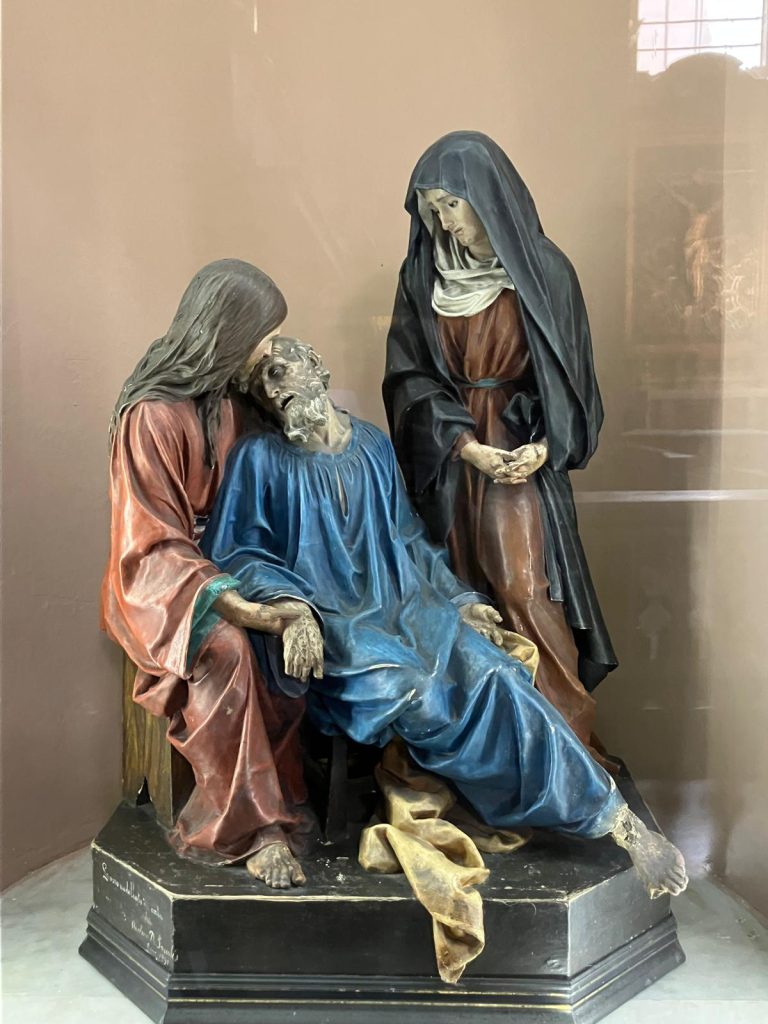
Photo taken at the Chiesa di San Giuseppe dei Padri Teatini, a 17th-century Baroque church located at the Quattro Canti intersection in Palermo, Sicily by Bernadette Leone.
My father left the house for good when I was two, leaving my mother to care for six children (I was the youngest) and my grandmother. My mother, who only had two years of college at that point, went back to complete two years in one, getting a teaching degree and moving us from Seattle down to Portland, Oregon when I was five. Evidently, though I don’t remember it, my father had visitation rights and would pick me up in his car and take me to his apartment once a week when I was three and four. Now, most of this experience I had little memory of; it filtered down to me through family lore and stories told and retold. If you asked me in high school if I missed not growing up with a father, I would have said, “No, I feel fortunate, since most of my friends have fathers who don’t act like fathers are supposed to.” I did not meet my dad until I was in twelfth grade. He moved back into town and wanted to reconnect. I said to a friend afterwards, “It’s not that he’s a bad guy, just sort of like a stranger on the street.”
What does all this have to do with Joseph or the celebration of his feast day? Joseph is our model of a good father, and was absent. Well, in a way I did grow up with a father of a sort. My brother, Neil, was five years older than me and he became my father figure. We did quarrel for a year when I was eight and he was thirteen, but then peace descended upon us. Later in life I asked him why that change occurred, and he said, “I just decided to be a good big brother.” And he was. He taught me how to field and throw a baseball, how to throw a spiral pass, how to backpack into the wilderness, and how to drive a stick shift. Neil also gave me good books to read in high school and gave me a desire in college to strive for academic excellence. He went from Reed College to Columbia for his masters, then on to Harvard
where he earned his PhD. and taught, before accepting a position in the history department of Florida State in Tallahassee. When I became a Christian in college and began studying for ministry in the Methodist church, Neil encouraged me in my direction, even though he himself had become quite agnostic. Also, he was the family historian and he loved local history.
Therefore, when he proposed in 2015 that he and I take a road trip from Tallahassee to New Orleans and the nearby town of Patterson, Louisiana to visit where my dad grew up, I knew it would be a fun time. Indeed, we stopped in Georgia along the way to hear jazz in a country bar, and went on eventually to Austin, Texas to hear more music. That the highlight became Patterson was unexpected.
This was four years before I was received into the Catholic Church at Saint John the Evangelist Parish in Jackson, Michigan, but I knew my dad had been a Catholic. In fact, my oldest sister and brother attended a Catholic grade school and received first communion.
Patterson’s parish is Saint Joseph’s, but that was not our destination. Instead, we went to the nearby Cathedral of Saint John the Evangelist in Lafayette, Louisiana, where my father was baptized and where some of his family members were buried in the cemetery. We found the grave markers, first, then made our way into the church. As I approached the altar, I saw to the right, a unique painting that I did not at immediately understand. It looked like the Pieta, but Jesus was in the position of Mary doing the holding—in the same position as Mary. Then it struck me—Jesus was holding his dead father Joseph, just as Mary would later hold her dead son. A strange moment of forgiveness fell upon me. My father had not been perfect. I know that
he had repented, turning to God at the end of his life. Here was an invitation to let go of any wounds I was holding on to and commend his soul to our merciful Savior. Maybe you can ask Saint Joseph to help hold your father, even if he was not perfect—by expressing to him the strengths you did gain from him.
February 13, 2026
To Behold the Beauty of the Lord!
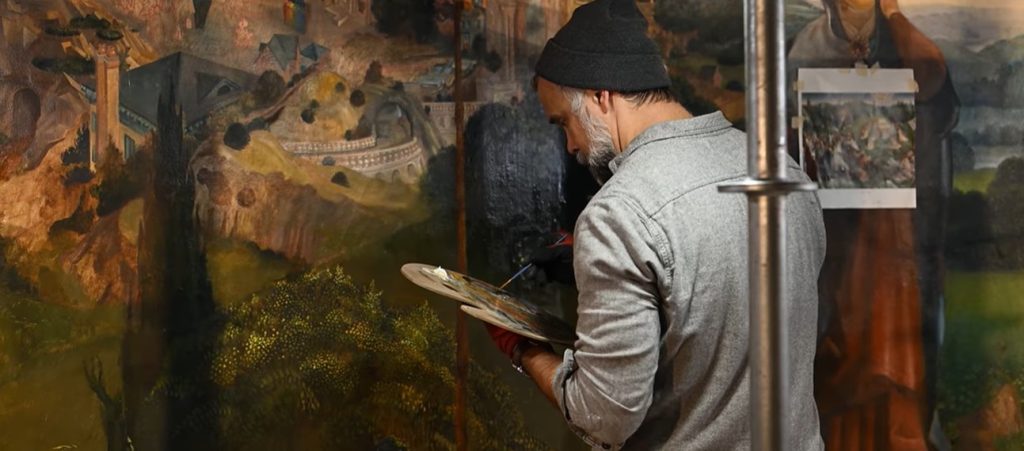
“This project is ultimately a visual piece that is intended to highlight a conversation with the congregation. A discussion that ultimately asks each participant in the congregation to encounter God.” – Joseph Macklin
Joseph Macklin’s 2025 masterpiece of a mural—painted on the apse of Saint John the Evangelist Church in Jackson, Michigan—stands as a work of contemplative beauty. Its three-tiered scope takes us from the heavenly Supper of the Lamb above, surrounded by saints and angels (a cloud of witnesses), into the middle level of everyday life in Jackson, Michigan—with its familiar downtown architecture of churches, high school, library, and businesses, and finally, to the lower level of the Holy Week Triduum, with Mary and John at the foot of the cross in the center.
One cannot help but be drawn contemplatively into the various scenes. In fact, to celebrate Eucharist at Saint John, with the priest elevating the host, raises one up, through the sacrifice of Christ’s body and blood, towards the lamb of God above, slain to take away the sins of the world. Bishop Robert Barron, following one of his theological heroes, Hans Urs Von Balthasar, often suggests that beauty is a good way to begin evangelizing our skeptical, relativistic culture. In an era that loves to diminish truth and goodness, beauty can still draw in people powerfully. That is the effect of Macklin’s masterpiece; it draws us into truth through beauty.
Back in college, not long after Christ found me, I began memorizing Scripture—key New Testament verses, but also entire Psalms. One of my favorite Psalms over the years has been Psalm 27. You may recognize the first line of the Psalm since it appears often in liturgical antiphons and the daily readings: “The Lord is my light and salvation; whom shall I fear?”
Recently, around the dinner table with friends, the question was posed for everyone to answer: “What is the Bible verse that serves as a guide for your life?” Particular verses in Psalm 27 have stood out during particular stages of my life and yet one has gradually emerged as my favorite, verse four: “One thing have I asked of the Lord, that will I seek after, that I may dwell in the house of the Lord all the days of my life, to behold the beauty of the Lord and to inquire in his temple.” I realized as we went around the table to answer the question, that Psalm 27:4 had become my life verse. This was partly due to my love for the church—a deep desire to behold the beauty of the Lord in his temple, in the church, through the Word and through the liturgy. That desire eventually led me to the Catholic Church, after spending three decades serving as a United Methodist minister.
Worshipping at Saint John since the unveiling of the apse mural fulfills this life-long desire of mine—to behold the beauty of the Lord and to inquire in his temple. Notice, too, that Psalm 27:4 begins with the bold statement, “One thing have I asked for.” What is it human beings desire most? Is it not intimacy with God? Isn’t that what we were created for in the garden—to love and adore God, to worship and serve him. Mary at the feet of Jesus desired only “one thing,” and Jesus told her sister Martha that Mary desired the better part.
Even before Macklin’s masterpiece was unveiled on Christmas Eve 2025, the Saint John motto was “Come and see.” How very fitting. Early in John’s Gospel, two disciples of John the Baptist follow Jesus. Jesus turns and asks them, “What are you looking for?” They stammer, “Where are you staying?” In other words, we want to be with you, to remain in your presence. Our Lord replies so tenderly, “Come and see.” Macklin’s mural at Saint John beckons: Come and see, come and worship, come behold the beauty of the Lord and inquire in his temple.
July 21, 2025
Saints Preserve Us!
Here at Fish on Fridays we aim to introduce people living around the Great Lakes, or people visiting the region, to the Saints that have gone before us here—Bishop Baraga, Blessed Solanus Casey, or the North American martyrs, for instance.
One of the most difficult practices for many non-Catholics to fathom is devotion to the Saints. Although Saints are not a difficult concept for any of us to understand, some misconceptions may need clarifying. One of the most common misunderstandings concerns why Catholics worship Saints, or why we pray to Saints (especially to Mary) instead of going straight to Jesus. What ought to be stressed at the outset is that worship is something reserved for God alone—Father, Son, and Holy Spirit. Catholics do not worship Saints. Instead, they honor or venerate them—turning to them for inspiration, for sources of imitation, and to ask for their intercession.
Any Christian can understand the need for inspiration when it comes to living the life Christ offers just as any athlete needs inspiration to pursue the rigors of a sport. “Discovering the Catholic Church,” said G. K. Chesterton, “is perhaps the most pleasant and straightforward part of the business; easier than joining the Catholic Church and much easier than trying to live the Catholic life” (The Catholic Church and Conversion, 91). We need encouragement from coaches who model the rigorous Christian life.
Consider, then, whom you admire, those you imitate. At one level we respect great sports heroes, musicians, and actors. But at another level, there are people who have contributed greatly to our development as human beings—a coach, high school teacher, or grandmother. At still another level, we can recall people who have shaped our faith—perhaps again, a coach, high school teacher, or grandmother. Many of us also have been influenced by pastors, priests, or Christian authors. Most Christians, for example, appreciate the clarity C. S. Lewis brings to the Faith. G. K. Chesterton was another thinker who became a personal mentor for me through his writing and example.
One of the best reasons to consider studying the lives of the Saints is because they illuminate—in different life situations and contexts—what it means to follow Christ. The Catechism suggests that “By canonizing some of the faithful, i.e., by solemnly proclaiming that they practiced heroic virtue and lived in fidelity to God’s grace, the Church recognizes the power of the Spirit of holiness within her and sustains the hope of believers by proposing the saints to them as models and intercessors” (CCC para. 828, italics added). When the Church began to convert the “barbarian” tribes in Western Europe in the 7th century—the Franks, the Celts, the Visigoths, Ostrogoths—bishops and priests streamlined catechesis to Gospel stories and lives of the Saints. Why? First, because the Gospels and lives of the Saints are communicated in story form, clothed in human narrative as it were. Second, because both the Gospels and the Saints represent a kind of distillation of the Christian life—giving us focused examples of what it means to follow Christ. A famous saint’s story itself offers just such an experience of influence in 1521. When Ignatius of Loyola was convalescing in the family castle after being wounded in battle by a cannon ball, he read two sorts of books. The first, about adventurous lives of chivalry (the rich and famous), left him feeling depressed. The second sort about the life of Christ and of the Saints inspired him, encouraging him to live for God just as the Saints had.
We need coaches in life. We long for inspiration that can stir us to strive after our best selves. The Apostle Paul wrote the Corinthians: “Be imitators of me, as I am of Christ” (1 Corinthians 11:1). Look to Christ. Yes. But it may help also to look at those who have already lived the Christian life we are trying to live now. The author of Hebrews spends the whole of chapter eleven recounting the Saints and heroes, not only of the Old Covenant, but extending his litany into the martyrs of the Church. His conclusion comes at the beginning of chapter twelve: “Therefore, since we are surrounded by so great a cloud of witnesses, let us also lay aside every weight and the sin that clings so closely, and let us run with perseverance the race that is set before us” (Hebrews 12:1). In the Great Lakes region, we too are surrounded by a great cloud of witnesses.
One of the beautiful things about the Saints is their great variety and their deep humanity. “How monotonously alike all the great tyrants and conquerors have been,” suggested C. S. Lewis; “how gloriously different are the saints.” What that means is that we will discover Saints that particularly fit us—who seem to speak our language and think our thoughts. Of course, the Saints are not perfected people, as we see in Scripture with figures like the patriarch Jacob or the disciple Peter. Yet Saints are honest. Therese of Lisieux knew her weaknesses—and held her littleness a badge of the mercy of Jesus. Chesterton wrote: “There are saints indeed in my religion; but a Saint only means a man who really knows that he is a sinner.” Perhaps that is why we sense them as accessible—I’m often more like a half-converted Peter than I am like Jesus. The reason we look to the Saints of our area of the Midwest is because we hope to become more like them.
We would naturally ask help from a coach, teacher, or grandparent. Asking the Saints to pray for us, therefore, to intercede for us, is similar. Our conviction that the Saints are resources for prayer rests on our belief in the Communion of Saints. Although someone has passed from this life, belief in the Communion of Saints assures us that those who have “crossed over” are not really separated from us. For instance, if Blessed Solanus Casey still tended the door at Saint Bonaventure’s in Detroit, I might conceivably wait for hours in line to ask for his prayers. Since his soul has gone to be with the Lord, he sees more clearly now, and he still desires to intercede on behalf of God’s children.
To help us “run with perseverance the race set before us” the Church endorses the Saints for our inspiration, imitation, and intercession. Consider studying one of the holy men or women in our Great Lakes region. The closeness in proximity and time to our own lives and our ability to visit the places where they lived out their faith can encourage us in our own faith journeys. Why not plan a trip with family or friends this August to visit one of the shrines in our region? May the Saints preserve us.
June 23, 2025
Another Tale of Two Cities During This Jubilee Year
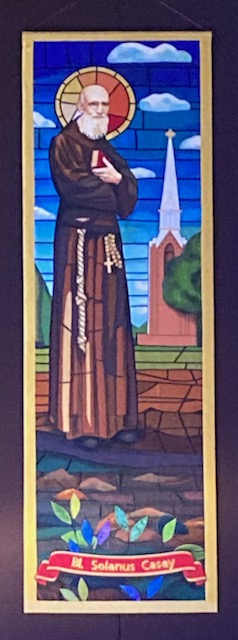
Most of our married life, when we had time off work, Kimberly
and I would spend much of it with family. Since we have become Catholic—our daughter, Annesley, 2016, my wife Kimberly, 2018, and me, 2019— we’ve enjoyed attending Mass with family in Seattle, in Denver, in Kansas, and in the D.C. area where Annesley and her family live. As a recent convert, I have been surprised by the joy of experiencing the Mass in different cultural contexts.
How fun to discover in the Roman Liturgy not only continuity,
but color and change! It’s the same Mass wherever you go, no matter
what language or culture—the same divine worship of the One Holy Catholic and Apostolic Church proclaimed by Justin Martyr (d. 165)
and Hippolytus (d. 236). But the Mass also continually changes—not only according to liturgical seasons, or with Solemnities, but on each distinct Lord’s Day in every new place. One summer of travel, Annesley and I attended Mass in Appenzell, Switzerland, spoken in German; and on that same excursion, four of us participated in Mass in Porto Venere, Italy.
This past February, Kimberly and I visited a former student and
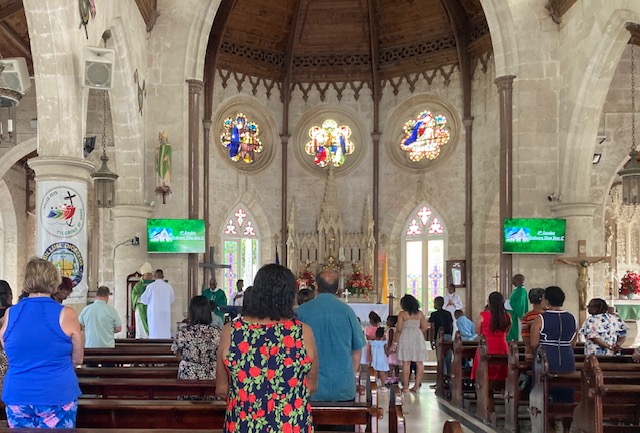
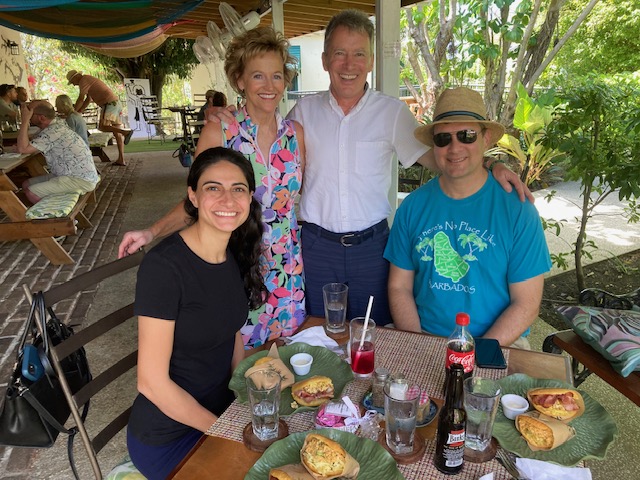
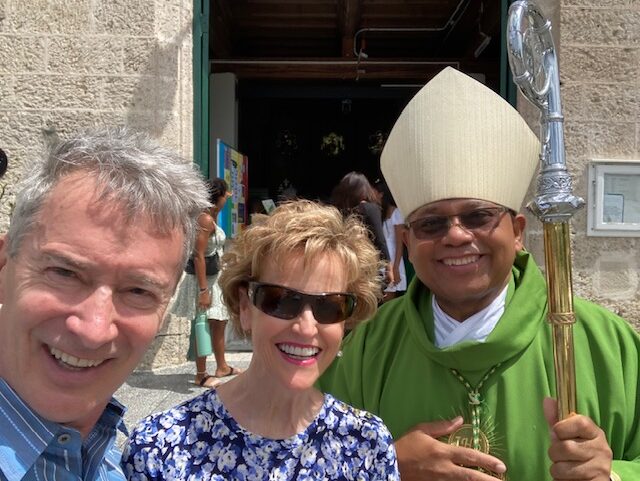
his family who works in the American embassy in Barbados. Yes, it was winter in Michigan; we were not going to fly to Barbados in August; but we went mainly to spend time with good friends. And it was a delightful experience—reconnecting with our friends and their kids, eating out, laying on the beach, visiting local museums. But the highlight was Mass. It was Sunday morning, and we picked the closest Catholic Church within walking distance. It happened to be St. Patrick’s Cathedral. Little did we know what was planned for that day, February 16th , the Sixth Sunday in Ordinary Time. Barbadian Bishop Neil Sebastian Scantlebury presided, not merely over the Mass but over the consecration the cathedral as a Year of Jubilee Pilgrimage site. The service was lively—the music, the homily, the liturgy—all with color and tempo and joy. When announcements came at the end, ninety minutes into the service, we knew we had stumbled into an especially sacred space and time. “Everyone with a birthday stand …. Let’s sing to them.” Ten minutes later: Anyone with an anniversary stand ….” Ten minutes after that: “Do we have any visitors?” and so on. It was marvelous. After the service we asked Bishop Scantlebury if we could take a picture with him in front of the cathedral. When we returned to Jackson, Fr. Chas noted: “You may be the first people at St. John’s to receive a Jubilee Indulgence this year.” And he was probably right.
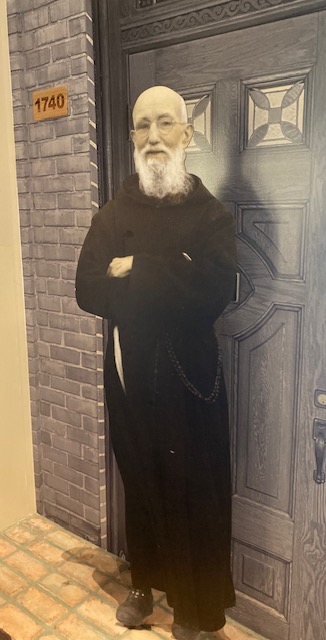
As wonderful a pilgrimage as Barbados became for Kimberly and me, I hesitate to compare it with the pilgrimage Lucian and I took recently to Detroit. Both were fabulous in their own ways. Lucian has recounted our Detroit excursion well in his recent blog. What I’d like to focus on here is our visit to the Blessed Solanus Casey Center at Saint Bonaventure Capuchin Monastery. Kimberly and I had been to the center once before—with Lucian and his wife Bernadette—and I can recall almost exactly how long ago it was, because we prayed at Blessed Solanus’s tomb for our granddaughter, who is now three-years and almost two-months old, but who was then still in utero. All grandparents think their grandchildren are magnificent miracles—but ours really are. Haha. Seriously, from the start I was drawn to Blessed Solanus Casey—not only by his miracles, but through his heart for listening to people; his deep, simple compassion and mercy; and I was drawn by his enormous faith, which issued from a deep contemplative connection with God. Blessed Solanus was plain—a typical Midwesterner in many ways—yet he was powerful; he was humble—very common—and yet thoroughly holy. To discover—in our own backyard as it were—a saint so relatable is a wonderful gift. I hope you will consider planning a pilgrimage to the Blessed Solanus Casey Center sometime this year.

Blog Entry March 2025
“Why I am Interested in the Transformation of Catholic Culture”
My interest in the transformation of Catholic Culture derives at least
partially from teaching spiritual formation for thirty years. Questions of human transformation necessarily involve the forces surrounding us—the influences of family, church, education, local community,
nationality, ethnicity, and socio-economic status—it is primarily
forces like these that shape our thoughts and behaviors. As much as we might like to imagine our lives are the products of our free will and personal choices, in actuality it is the broader effects of culture that have more sway.
I think it’s helpful to consider culture broadly. Culture is the air we breathe. For instance, culture consists of all the things we take for granted in modern Western society—indoor plumbing, central heating, and electricity; free press and the rule of law; mobility and instant communication; consumerism. I love the story that David Foster Wallace told about two young fish swimming along. From the other direction comes an older fish who comments, “Morning boys, how’s the water?” As he passes by, the two smaller fish look at each other confusedly and stop. One soon asks the other, “What the hell is water?” Culture is like the water we do not recognize ourselves swimming in. We take it for granted. For instance, most suburban teens in Detroit probably do not recognize the unique elements of American culture that are shaping them and how those characteristics contrast with, say, rural Asian culture.
We can all agree that some cultures are healthier than others—even as some nations, or churches, or communities, or homes are either healthy or sick. Much of the rest of the world has begun to adopt influences from the West uncritically, so that fast food culture, individualism, pop music, professional sports, and social media have become worldwide cultural phenomena. Not all these influences are necessarily healthy, however. And if we fall into unhealthy cultural patterns, how do we reverse the situation? How do we heal the culture of an ailing home, church, school, or business?
Spiritual formation is about transformation. As C. S. Lewis argued in his classic book Mere Christianity, each of us is being formed spiritually moment by moment. It’s not a matter of whether we will be spiritually formed—only whether we will be formed into creatures that are more human or less human. If the Church does not form us, in
other words, if we are not shaped by Christ and our Catholic faith, our surrounding culture will form and shape us instead. If we do not allow Christ to shape us, we will be shaped by the forces of media,
consumerism, moral relativism, and the like.
What we ought to recognize also is that it is much harder to extricate ourselves from cultural influences once we’ve accepted them. Few of us will stop driving our cars or give up our cell phones, even if we come to understand their negative effects on our lives. We are creatures of habit. If this is true, we ought to approach cultural influences with caution and learn to guard ourselves against those who profit by drawing us into cultural fads.
As with any human habit, one habit can best be replaced by another, stronger or better habit. An addiction to fast food, for instance, can be countered by fasting. Let’s call this the principle of displacement. Thus, a negative cultural influence can best be expelled by a more positive one. Think of how you can get rid of some of the water in a full bathtub by putting yourself into it. As you get into the tub, your body mass will displace a certain mass of water, unfortunately onto the floor of your bathroom in this case. This example is for illustrative purposes only, not as a recommended science project to try at home.
What FishonFridays hopes to encourage is the growth and maintenance of healthy Catholic culture—through families and friends sharing their faith—by moving away from some of the destructive, self-centered features of modern American culture, and by re-learning how to be more fully human through face-to-face interactions of incarnational feasting and play. Stay tuned to FishonFridays for examples of how to displace insidious cultural influences with god-fearing and humanizing ones.
“If you do not have mirth, you will certainly have madness.” (G K Chesterton)